« My first skein. | Main | Life is... »
Monday June 30, 2008
Books in June
Kids' stuff...
- Borrower of the Night Elizabeth Peters
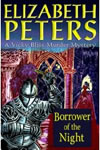 Again I picked this author originally due to a similarity to "Ellis Peters" and was smitten by the concept of Victorian archeologists combined with Thriller/Detection. However, I was not very thrilled with the 'Amelia Peabody' series, and laughed out loud at the book blurbs declaring "an author so popular that copies of her books in the public libraries have to kept under lock and key!" [on which planet I wonder?].
This book is a 'Vicky Bliss' mystery. The first in the series, written in 1974, and quite interesting for me to read a contemporary view of modern manners - I would say "to remember" but I was not quite adult enough in the 1970s to take anything other than the subjective view of a participant. Vicky Bliss is just as irritating as Amelia. Need I say more? Strangely enough I find this author's more serious writing - which you get to experience in the Amelia series when Amelia's children take over the narrative - quite good; however I don't really enjoy what I imagine to be tongue in cheek humorous stuff which is exhibited through Amelia, and to some extent Vicky.
The view of the 1970s, in combination with the antagonistic relationship of hero and heroine brought back memories - not only Mills and Boon but - of Mary Stewart. I realised I have not given her books a thought for at least 30 years.
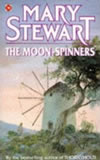 I read her novels initially as mystery/suspense/thrillers - but in fact I am sure I took to them as much for the romance angle. To quote from Wikipedia she maintains "a full mystery while focusing on the courtship between two people"; I note that they also say that she was "at the height of her popularity in the 1960s and 70s", though I also notice these novels were written more in the 1950s.
She writes unashamedly to a very specific formula - and is successful every time I would say. She has an exotic picturesque setting, a 'difficult' man (who turns out to be "the one"), often some protegé, (maternal instincts), and the element of danger and mystery. Perfect fodder for the teenage me.
I read her novels initially as mystery/suspense/thrillers - but in fact I am sure I took to them as much for the romance angle. To quote from Wikipedia she maintains "a full mystery while focusing on the courtship between two people"; I note that they also say that she was "at the height of her popularity in the 1960s and 70s", though I also notice these novels were written more in the 1950s.
She writes unashamedly to a very specific formula - and is successful every time I would say. She has an exotic picturesque setting, a 'difficult' man (who turns out to be "the one"), often some protegé, (maternal instincts), and the element of danger and mystery. Perfect fodder for the teenage me.
In this respect, it came to me that there is a strong similarity to Dick Francis - another favourite, and excellent thriller writer. It is really no surpise to relate these similarities to the acknowledged fact that Francis's wife contributed many ideas to his books. He has a hero rather than a heroine, of course, but always very sensitive with a bittersweet emotional intensity. He also chooses a specific setting though usually by means of an unusual job for his hero.
Mary Stewart also wrote fantasy/historical novels (the Merlin series) in which I was not so interested, even though historical novels were a mainstay of my reading materials of that time. This led to more memories of such intensity, I was compelled to go and review my own bookshelves, and then wander through a maze of internet pathways to recall authors that I am ashamed to say I had simply forgotten.
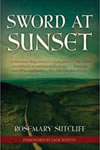 At school we were generally encouraged to read historical novels for children - by 'suitable' authors, naturally. I began with
Rosemary Sutcliff's
Eagle of the Ninth first published in 1954. It is set in Roman Britain in the 130s and follows the story of a boy's search to discover the truth about the disappearance of his father's legion in the north of Britain. This was the first in a sequence of novels: The Silver Branch, The Lantern Bearers, and Sword at Sunset. This last one is really an adult book, and is a modern interpretation of the legends of King Arthur. This is the one in residence on my bookshelf. I feel I ought to read it again - though all I remember of it is that it is unbearably sad. I must say that I did not even realise it was related to her other Roman books in any way.
At school we were generally encouraged to read historical novels for children - by 'suitable' authors, naturally. I began with
Rosemary Sutcliff's
Eagle of the Ninth first published in 1954. It is set in Roman Britain in the 130s and follows the story of a boy's search to discover the truth about the disappearance of his father's legion in the north of Britain. This was the first in a sequence of novels: The Silver Branch, The Lantern Bearers, and Sword at Sunset. This last one is really an adult book, and is a modern interpretation of the legends of King Arthur. This is the one in residence on my bookshelf. I feel I ought to read it again - though all I remember of it is that it is unbearably sad. I must say that I did not even realise it was related to her other Roman books in any way.
I remember her as an excellent writer, and we all fell in adolescent love with her heroes, (Beowulf, for example...!).
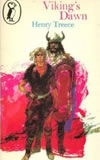 I then remembered
Henry Treece . I had somehow managed to totally wipe him from my memory. He was a little more 'serious' for me than the female writers, but I was drawn into his work by the desire for more "Roman" fiction, and then on to his Viking Series. The Eagles Have Flown published in 1954, deals with Britain after the Romans, and and again with the supposed historical figure behind the legends of Arthur.
I then remembered
Henry Treece . I had somehow managed to totally wipe him from my memory. He was a little more 'serious' for me than the female writers, but I was drawn into his work by the desire for more "Roman" fiction, and then on to his Viking Series. The Eagles Have Flown published in 1954, deals with Britain after the Romans, and and again with the supposed historical figure behind the legends of Arthur.
Much as I am inclined to do today, I think I read a 'set' of books on Arthur - the third of which was T H White's famous Once and Future King - which again was suited to the adolescent reading transition from child to adult.
Even more amusingly, just like moving from Ellis Peters to Elizabeth Peters - Henry Treece led me to Geoffrey Trease (nearby on the library shelf) - another author of children's historical novels. So perhaps my easy substitution of names is not due to old age and loss of marbles, but simply a genetic trait after all...
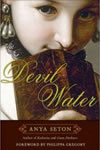 Finally I need to mention a book which I have not read at all! When I was at school our Deputy Head Mistress, Mrs McCarthy - amazing woman, straight out of he 1940's complete with hair roll - taught us not only about ladylike manners, and what make-up was suitable for young women (ie none), but also history. This included the Jacobite rebellions of 1715 and 1745; apart from the rather fundamental difference of which King or Prince was "pretending" at the time, we always got the events and battles muddled. Her advice (more than once) was to read a "very good book" by
Anya Seton and "you will never mix them up again". I think this must have been Devil Water as it's about the Earl of Derwentwater and his involvement with the Jacobite rising of 1715, and his brother Charles, beheaded after the 1745 rebellion, the last man to die for the cause.
Finally I need to mention a book which I have not read at all! When I was at school our Deputy Head Mistress, Mrs McCarthy - amazing woman, straight out of he 1940's complete with hair roll - taught us not only about ladylike manners, and what make-up was suitable for young women (ie none), but also history. This included the Jacobite rebellions of 1715 and 1745; apart from the rather fundamental difference of which King or Prince was "pretending" at the time, we always got the events and battles muddled. Her advice (more than once) was to read a "very good book" by
Anya Seton and "you will never mix them up again". I think this must have been Devil Water as it's about the Earl of Derwentwater and his involvement with the Jacobite rising of 1715, and his brother Charles, beheaded after the 1745 rebellion, the last man to die for the cause.
Sounds great doesn't it? Maybe they have it in the library...
I shall end here - Mrs McCarthy was also our English teacher, and asked my parents what I (aged 12) read, as my writing style was not very good. [And the answer was Agatha Christie - so her inferences were probably correct].
Posted by Christina at 11:27 PM. Category: Books of the Month